ServicesReverse Osmosis
Reverse Osmosis Systems in Missouri City
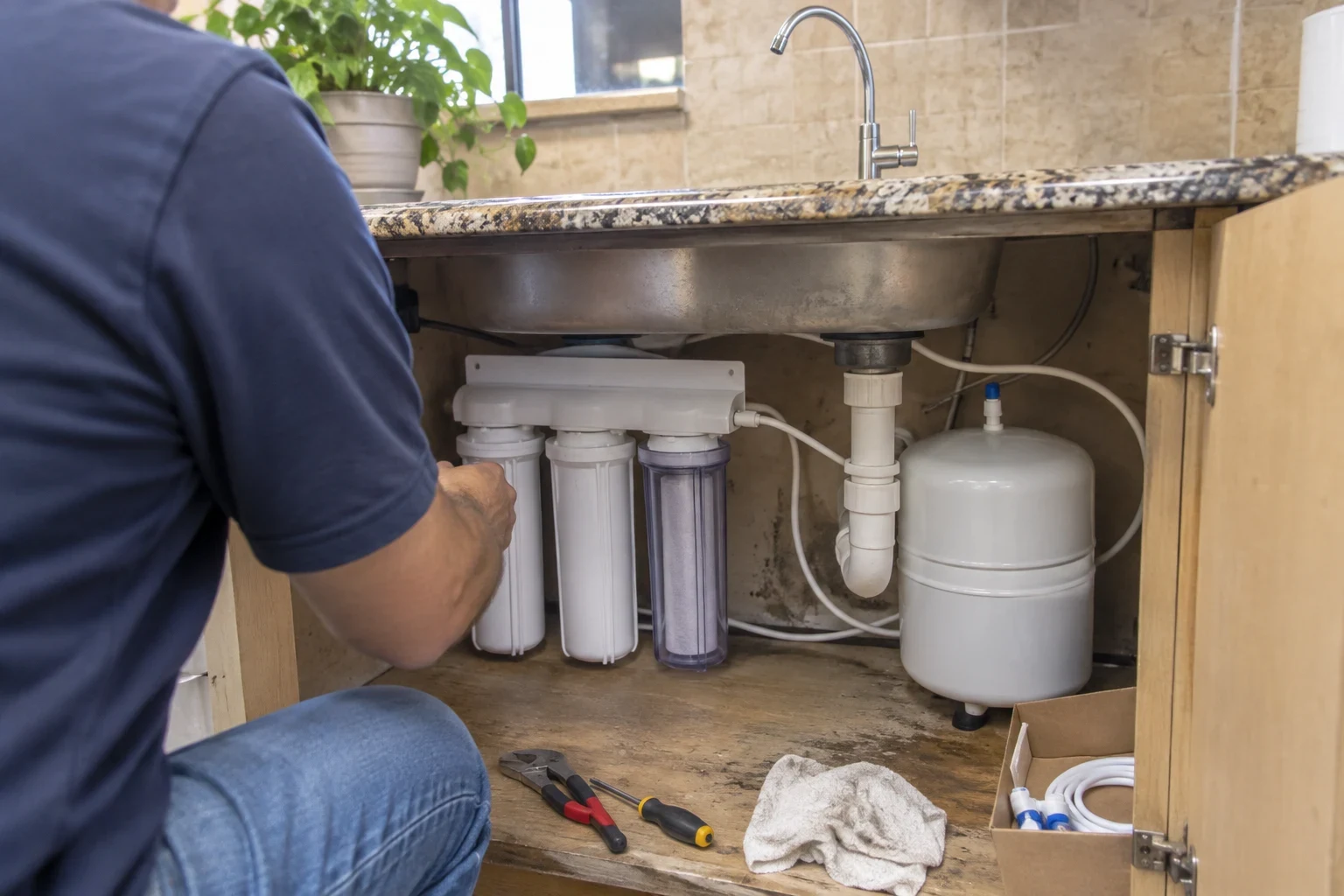
An under-sink reverse osmosis system filters the water you drink and cook with and delivers it through a separate faucet beside your main tap. We match the unit to your water and the cabinet it lives in, and you see the filter schedule and its cost before installation day.
What reverse osmosis does at your kitchen sink
Inside the unit, the pressure already in your lines pushes water through a semipermeable membrane with pores fine enough to hold back most dissolved solids. Lead from older fixtures and a long list of trace contaminants are left behind, and carbon stages ahead of the membrane strip out the chlorine taste before the water reaches it. What ends up in your glass is clear and neutral, close to good bottled water.
The system sits at one faucet, so it handles the water you drink and cook with while showers, laundry and the dishwasher keep running on your regular supply. That narrow job keeps the equipment compact and the yearly upkeep modest. For treated water at every fixture in your home, our whole-home filtration page explains that option, and the two work well together.
We plan it the way we would plan our own. Before you agree to anything, you should know what the system will ask of you over five years, rather than learning it at the first filter change.
What comes with an installed system
Three filtration stages
Sediment and carbon prefilters guard the membrane from grit and chlorine, and a carbon polishing cartridge after the storage tank cleans up the final taste. Each cartridge does one job and has its own change interval.
A faucet that matches your kitchen
Choose from finishes like brushed nickel, matte black or chrome so the drinking tap looks at home next to your main fixture. If the counter already has a spare opening from a side sprayer, we reuse it; if not, we bore a neat new hole.
Storage tank or tankless
A small pressurized tank holds a few gallons ready to pour. A tankless unit filters as you draw and leaves more room in a cabinet already crowded by a disposal.
Refrigerator and ice maker line
If you like, we tie filtered water into your fridge so the ice comes out clear and has no taste of its own.
Installation and ongoing service
Installation is free, and we offer full services after the sale, including filter changes and membrane replacement when it comes due.
Signs an RO system makes sense for you
The recycling bin fills with water bottles
Bottled water costs money on every trip to the store and takes up pantry space. A system under the sink covers most of what you drink without the hauling.
Coffee and tea taste off
Chlorine and mineral flavors come through strongest in hot drinks. The carbon stages and membrane in an RO system remove both.
Older plumbing or fixtures
Brass fixtures and older solder can release lead into water that sits in the lines. Reverse osmosis is among the most dependable ways to treat it at the tap you drink from.
Spotted glasses and a scaled kettle
A white film on glassware and crust inside the kettle come from dissolved minerals. RO takes them out of your drinking water; for the rest of the house, a water softener is the better tool.
A test flagged your water
When water testing finds high total dissolved solids, nitrates or other contaminants, RO is often the focused answer for the water you actually consume.
How the work goes, from first call to first glass
- 1
Talking it through
Your first call is a conversation about what bothers you in your water and what the space under your sink looks like. When it is useful, we measure dissolved solids and incoming pressure, because the membrane depends on steady pressure to do its work.
- 2
Picking the system and finish
We suggest tank or tankless, any add-ons worth having and a faucet finish. You receive a written equipment list along with the filter schedule that comes with it.
- 3
Installation day
We put down a protective mat in the cabinet, mount the unit, tap the cold feed line, fit a drain saddle and set the faucet. In most homes the kitchen is usable again within a few hours.
- 4
Flush, test and hand-over
New cartridges are flushed, every connection is checked for drips, and we show you how the system reads. You keep a dated schedule for each filter change, so upkeep is on the calendar long before it is due.
What moves the price of a reverse osmosis system
Two things set the upfront number: the equipment you pick and the work your kitchen needs to take it. After that, the running cost is filters each year and a membrane every few years. We write both down so they become a planned expense instead of a surprise.
- Tank or tankless
- Tankless systems cost more at the start but take less cabinet space and often send less water to the drain. Tank systems are simpler and have a long record of reliability.
- Countertop material
- An existing opening keeps the job quick. Quartz and granite need the right drill bit and a slower hand, and that time is part of the estimate.
- Add-ons
- A fridge line, a permeate pump for homes with low pressure, or a remineralization stage each adds to the system. Remineralization ties in with our alkaline water systems.
- Filter and membrane upkeep
- Prefilters usually need changing about once a year, and membranes last a few years, less with hard or sediment-heavy water. Planning for this now turns upkeep into small, expected visits.
Reverse osmosis questions we hear often
Something not covered here? (281) 853-8856
Does a reverse osmosis system waste water?
Some water always goes to the drain, because that flow keeps the membrane rinsed. Current designs use far less than older units did, and a permeate pump lowers the ratio further. We will give you the expected figure for the model you pick.
Is there room for it if my sink already has a garbage disposal?
Usually, yes. Tankless units are slim, and a storage tank can stand to one side of the cabinet or go in the cabinet next door. We look at the space first and only then recommend a model.
Does RO remove healthy minerals?
Yes, the membrane takes out most dissolved minerals, calcium and magnesium among them. For most people, food supplies the bulk of those. If you would like some back in your glass, a remineralization stage adds a small amount after the membrane.
Who installs and services the system?
Our own team handles both. We hold the Certified Water Specialist credential from the Water Quality Association, and that same standard carries into the filter changes and membrane service we provide after the sale.
Do I need a water softener first?
Not necessarily. Very hard water wears out a membrane sooner, so we check hardness before deciding anything. If a softener is worth adding, our water softeners page explains how the two divide the work.
Get your drinking water planned before the next bottle run
Give us a sense of your sink, your counter and what you would change about your water. We will recommend a system, a faucet finish and a filter schedule you can budget around.